
A Broker of Record form is a whole lot more than just another piece of paperwork. Think of it as a legally binding document that officially hands over the keys to a client's insurance policy from their old agent to you. This single form unlocks new business, making it an absolutely critical tool for any growth-focused independent agency.
Getting the preparation and submission process down to a science isn't just a good idea—it's a non-negotiable skill in this business.
Why the Broker of Record Form Is Your Agency's Most Important Document
In the competitive fight for new clients, the Broker of Record (BOR) form is your frontline weapon. When a business decides it's time to switch its insurance representation, this is the document that makes it official. It’s your formal notice to the insurance carrier that your agency is now in the driver's seat, giving you the power to manage policies, negotiate better terms, and handle claims on your client's behalf.
Without a perfectly executed BOR form, you have no legal standing with the carrier. It doesn't matter how great your relationship with the client is. The BOR is the mechanism that turns a handshake agreement into a real, revenue-generating partnership.
A Strategic Tool for Growth
For independent agencies in Georgia, Alabama, and Mississippi, you have to see the BOR process as a strategic move. This isn't just another administrative task to check off the list; it's a direct path to growing your revenue and locking in client retention. A smooth, professional BOR transition immediately shows your new client that your agency is competent and sets a positive tone for the relationship right from the start.
In most cases, the insurance world operates on a "first-come, first-served" basis with BORs. The first broker to get a complete and accurate form into the underwriter's hands wins the business. That’s it. This makes the timing and accuracy of your broker of record form submission absolutely critical—it directly decides whether you or a competitor gets to manage that client's insurance program.
The ability to manage the Broker of Record process efficiently and accurately is a massive competitive advantage. It sends a clear signal to clients: your agency is organized, professional, and ready to act decisively for them.
The Foundation of Client Relationships
At the end of the day, a BOR form is a vote of confidence. It’s your new client’s official declaration that they trust you to do a better job than their last agent. This means every single part of the process—from how you prepare the form to how you submit it—is a direct reflection of your agency’s commitment to excellence.
For agencies serious about long-term success, creating a bulletproof process around this one document is one of the most effective insurance agency growth strategies you can possibly implement.
How to Prepare and Complete the Form with Precision
A flawlessly prepared broker of record form is your ticket to a smooth client transition. Get it wrong, and you're in for a world of hurt. A single mistake—a misspelled name, a wrong policy number—can get the form rejected, jeopardize the relationship, and even open your agency up to an Errors & Omissions claim.
Getting it right the first time isn't just a goal; it's a requirement for looking professional and securing the business you worked hard to win.
The prep work you do before the client ever sees the form is arguably the most critical part of the entire process. Before you even think about asking for a signature, you need to do your homework. That means gathering all the necessary documents and verifying every single detail.
This visual breaks down the straightforward path for a successful BOR transition, starting with solid preparation to lock in the account.
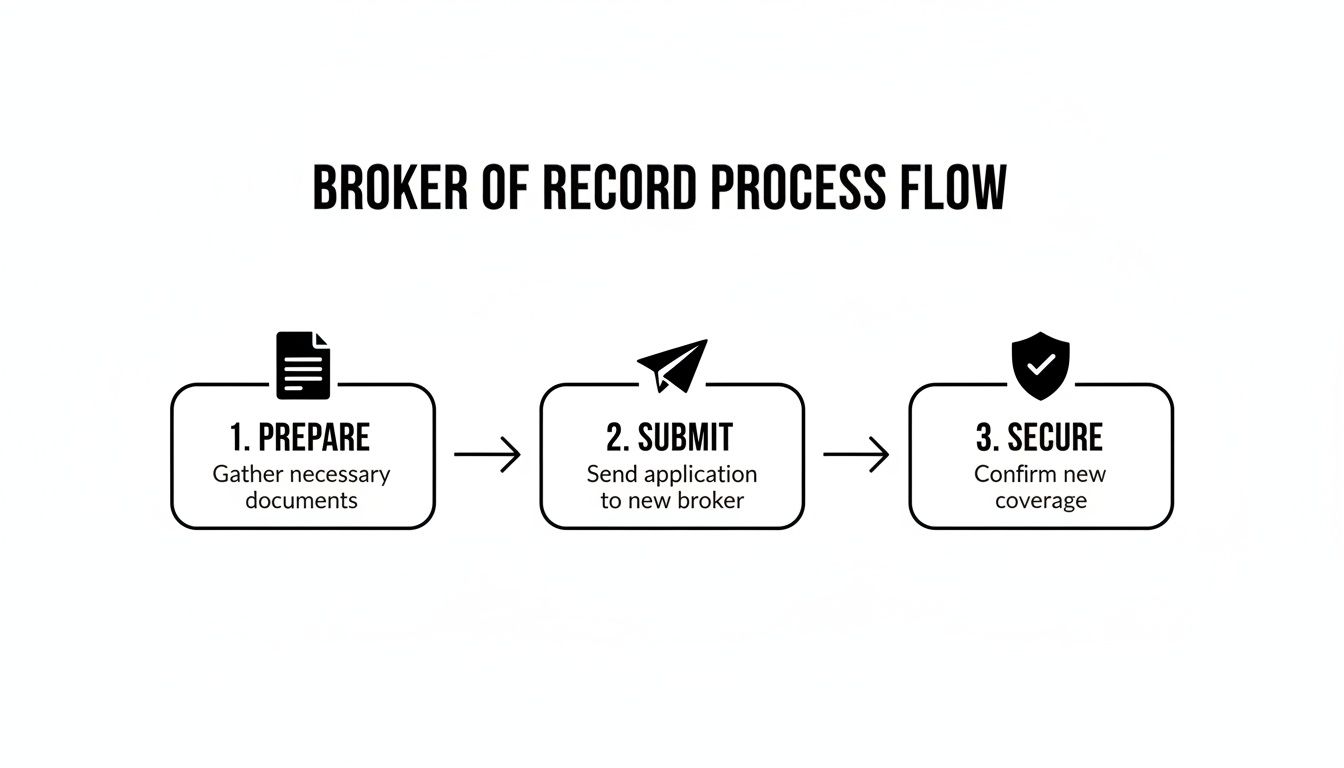
As you can see, meticulous preparation is the foundation for a seamless submission and a secure client relationship.
Assembling Your Pre-Submission Checklist
Think of this as building your case file. You need unassailable proof and accuracy before you proceed. Skipping this step is the number one reason BORs get delayed or denied by carriers.
Start by collecting this essential information:
- The Client's Exact Legal Name: This isn't the time for abbreviations or DBAs. You need the full legal name of the entity or individual exactly as it appears on their current insurance policies and corporate documents. For a business, this includes the full "Inc.," "LLC," or other designation.
- A Complete List of Policy Numbers: Get your hands on a declaration page for every single policy you intend to take over. This is the only way to guarantee you have the exact policy number, coverage type, and expiration dates. Using a partial number is a common mistake that guarantees a rejection from the carrier.
- Carrier and Incumbent Agency Details: You have to identify the correct insurance carrier for each policy. You'll also need the full name and address of the current (outgoing) insurance agency. This information is non-negotiable for the carrier to process the change correctly.
Once you have this data, double-check everything. A quick call to the client to confirm the spelling of their legal name can save you days of back-and-forth with a carrier.
Crafting the Language of the Letter
While many carriers and agencies use a standard template like the ACORD 36 form, the specific wording of your broker of record form still matters immensely. The letter has to be clear, direct, and completely unambiguous.
Your letter should always be on the client's letterhead and contain these core elements:
- Date of the Letter: This establishes the timeline for the change.
- Carrier Information: Include the full name and address of the insurance company.
- Clear Statement of Appointment: This is the most critical part. The language must explicitly state that your agency is being appointed as the sole broker of record for specific policies.
- Policy Identification: List every policy number and its effective date that this letter applies to. Never use vague language like "all policies."
- Revocation of Prior Authority: The letter must state that all prior letters of authority are rescinded and that the previous broker is no longer authorized to act on the client's behalf for these policies.
- Signature and Title: The letter has to be signed by an individual with the legal authority to make this decision. Their name and official title must be printed below the signature.
Sample Wording for the Body:
"This letter serves as formal notification that we, [Client's Full Legal Name], hereby appoint [Your Agency's Full Name and Address] as our exclusive insurance agent and broker of record for the policies listed below, effective immediately. This appointment supersedes and revokes any and all previous appointments. We request that you provide [Your Agency's Name] with all information pertaining to our insurance program."
This language is direct and leaves zero room for misinterpretation by the carrier.
Verifying the Signer's Authority
A BOR form signed by the wrong person is completely worthless. Before your client signs anything, you must verify that the individual has the legal authority to bind the company in these matters.
For a small business, this is often the owner. For larger corporations, it could be a CEO, CFO, or another designated officer.
Don't just assume. Ask the question directly: "Who at your company has the legal authority to sign documents related to your insurance program?" This simple act of due diligence protects both your agency and your new client. An invalid signature is one of the quickest ways to create an E&O nightmare.
Properly leveraging your agency management system to document these conversations is one of the most effective agency management tools for mitigating this kind of risk.
By building a meticulous, repeatable process for BOR forms, you transform an administrative task into a strategic advantage. It demonstrates your agency’s professionalism and competence from day one.
Navigating the Critical Post-Submission Period
Once your client signs the broker of record form and you send it off, the real race begins. Don't mistake this for the finish line; it’s the start of a delicate, time-sensitive phase where your new client relationship is most vulnerable. A signed BOR is a powerful statement of intent, but it’s not a done deal until the carrier officially recognizes the change and the crucial waiting period has passed.
The actions you take in the hours and days right after submission will make or break the transition. Your goal is to move from a signed paper to an officially recognized relationship with speed and professionalism, protecting the business you just worked so hard to earn.

Submitting the Form and Getting Confirmation
The moment that form is signed, the clock is ticking. Don't let it sit on your desk. Your first move should be getting that document to the right contact at the carrier as fast as you possibly can. Speed is your best friend here—it shows your agency is on the ball and gets you ahead of any potential moves from the outgoing broker.
Most carriers have their preferred ways of getting these documents:
- Secure Carrier Portals: This is usually your best bet. Uploading directly to a portal almost always generates an immediate, time-stamped receipt.
- Dedicated Email Addresses: Many carriers have a specific inbox just for BOR submissions. If you go this route, always request a confirmation of receipt in your message.
- Agency Management System (AMS) Integration: Some modern AMS platforms can fire documents directly to carriers, creating an invaluable digital paper trail for you.
No matter which method you use, never assume the carrier received it. You absolutely must get a dated and timed confirmation. That receipt is your non-negotiable proof of when you submitted it, which can be a lifesaver if the incumbent broker tries to challenge the change.
Understanding the Rescindment Period
After you submit the form, the carrier will let the outgoing agent know about the change. This kicks off what’s known as the rescindment period, and it's arguably the most nerve-wracking part of the whole process.
Insurance companies typically enforce a 5 to 10-day rescindment period after a BOR letter is submitted. During this window, the previous broker has a chance to contest the change, or the client can change their mind. This is a standard industry protection mechanism to give everyone a moment before the transition is set in stone. For independent agencies across Georgia, Alabama, and Mississippi, knowing how to manage this period is key to securing new business. To get more background on this practice, you can discover more insights about broker of record letters from Hylant.
Key Takeaway: Think of the rescindment period as a cooling-off window. The outgoing agent is almost guaranteed to call your new client to try and win them back. Your job is to make sure your client feels completely confident in their decision to switch to you.
Proactive Communication to Solidify the Relationship
How you communicate during these 5 to 10 days is vital. You can't just go silent and hope for the best. This is your chance to reinforce the value you bring to the table and reassure the client that they made the right call.
Immediately after you send in the broker of record form, get in touch with your new client. Thank them again for their trust and give them a quick rundown of what happens next. Critically, let them know the carrier will be notifying their old agent and that they should expect a call from them.
Giving them this heads-up does two important things:
- It prepares them for the call from the old agent. They won't be caught off guard, and it shows you know the process inside and out.
- It reinforces your role as their trusted advisor. You're actively guiding them through this, not just passively waiting for it to be over.
Managing the Outgoing Broker Professionally
The outgoing broker’s reaction can range anywhere from professional acceptance to an all-out push to keep the account. They might suddenly offer lower premiums, promise better service, or question the client's decision.
Your role here is not to get into a tit-for-tat with the other agent. Your focus has to stay on the client. If your client tells you the old agent called, listen to what they have to say. Then, calmly bring the conversation back to the reasons they decided to move in the first place—whether it was your agency’s better service, deeper expertise, or the more competitive program you put together for them.
Whatever you do, never speak badly about the other agent. Keep it professional. By staying calm and confident, you project the strength and stability that a client is looking for in their new insurance partner. This is how you turn a signed form into secured revenue.
State-Specific Rules for Georgia, Alabama, and Mississippi
While the core idea of a Broker of Record form is the same everywhere, things can get tricky when you cross state lines. For independent agents in Georgia, Alabama, and Mississippi, understanding the local quirks isn’t just about staying compliant—it’s about locking in new business and showing you’re a true regional expert.
Every state’s Department of Insurance has its own way of doing things, influencing everything from processing times to how they handle disputes. An agency operating across the PIA Southern Alliance region has to stay on its toes. A BOR process that's smooth sailing in Georgia might hit a wall in Alabama if you're not paying attention to the details.
Key Differences in BOR Handling Across the States
You won't find wildly different laws for the BOR process itself in these three states. The real differences pop up in how state regulators and individual carriers interpret agency appointments and deal with conflicts. This is where that on-the-ground, practical experience really pays off.
- Georgia's Approach: The Georgia Office of Commissioner of Insurance and Safety Fire likes things crystal clear. Carriers here are especially careful about confirming the signer's authority on a broker of record form, particularly for big commercial accounts. A form with a fuzzy job title or a signature that can't be easily verified is far more likely to get flagged for a second look in Georgia than in its neighboring states.
- Alabama's Focus: Over in Alabama, the Department of Insurance puts a heavy emphasis on proper agent licensing and carrier appointments. Trying to submit a BOR for a carrier you aren't appointed with yet will bring everything to a grinding halt. Their process tends to be more rigid, with very little wiggle room for fixing things on the fly.
- Mississippi's Perspective: In Mississippi, the vibe often leans toward consumer protection. The Mississippi Insurance Department wants to see undeniable proof that the switch was 100% the client's idea. Any hint of confusion or ambiguity in a contested BOR situation can make carriers stick with the incumbent agent just to keep things stable for the insured.
The Unspoken Rules of Contested BORs
When the outgoing agent decides to fight a BOR, the official rulebook often takes a backseat to the carrier's internal playbook, which is heavily shaped by the local regulatory climate.
If two competing BOR forms land on a carrier’s desk, they'll almost always honor the one with the earliest time stamp. Simple enough. But if the incumbent agent contests the change during that rescission window, the carrier's reaction can vary. In our experience, carriers in Georgia are more likely to request a clarifying letter straight from the insured. In Alabama, they might just freeze all activity on the account until the agents sort it out, which can quickly frustrate a new client.
Navigating a contested BOR isn't about winning a legal debate. It's about having your paperwork in perfect order from the start. The agency with the cleanest documentation—a clearly written letter, a verified signature, and a time-stamped submission receipt—almost always comes out on top.
Best Practices for Regional Compliance
To avoid these state-specific headaches, agencies in the PIA Southern Alliance should build a few key habits into their workflow. These practices will help make your broker of record form submissions as bulletproof as possible, no matter which state you're in.
- Verify Appointments First: Before you even think about submitting a BOR in Alabama, double-check that your agency has an active appointment with that carrier. Don't just assume an appointment for one line of business covers them all.
- Document Signer Authority: For any Georgia-based clients, make it standard practice to jot down how you confirmed the signer's authority. It can be as simple as a note in your AMS mentioning their corporate title and the date you spoke with them.
- Use Client Letterhead: Always, always, always get the BOR letter on the client's official letterhead. This small step adds a huge layer of authenticity that plays well with compliance departments in all three states, but especially in Mississippi.
When you're dealing with these state-specific rules, having a good grasp of contract interpretation principles can be a lifesaver, since the BOR letter is a legal document with real contractual power.
BOR Compliance Checklist for GA, AL, and MS
To help you keep these nuances straight, we've put together a quick-glance table. It’s a great tool for training new team members or for a final check before you hit "send" on that next BOR submission.
| Compliance Check | Georgia | Alabama | Mississippi |
|---|---|---|---|
| Signer Authority Verification | High Priority. Carriers scrutinize this, especially for large accounts. | Standard Priority. Good practice, but less frequently challenged. | High Priority. Essential for proving client intent if contested. |
| Active Carrier Appointment | Important. Required, but some administrative flexibility may exist. | Critical. Submissions without an active appointment are often rejected outright. | Important. A missing appointment can weaken your position in a dispute. |
| Client Letterhead | Strongly Recommended. Adds a layer of professionalism and authenticity. | Recommended. Viewed as a best practice but not always a deal-breaker. | Highly Recommended. Significantly strengthens the validity of the request. |
| Clarity of Intent | Very Important. Ambiguous language can lead to requests for clarification. | Important. Focus is more on procedural correctness than wording. | Critical. Any doubt about the client's choice can favor the incumbent. |
| Contested BOR Handling | Carriers may request direct client clarification to resolve disputes quickly. | Carriers may freeze account activity until the dispute is formally resolved. | Carriers often side with the incumbent if client intent is not perfectly clear. |
Ultimately, a proactive and detail-oriented approach is your best defense. By treating each BOR with the diligence it deserves, you're not just following the rules—you're building a reputation for professionalism.
Staying current on these regulations is non-negotiable. For more details on agent and agency requirements, the PIA Southern Alliance licensing information page is an excellent resource. Following these localized best practices doesn’t just prevent rejections; it builds your reputation as a sharp, compliant, and professional agency clients are eager to work with.
Common Mistakes That Create E&O Nightmares
Mistakes during the Broker of Record process aren't just frustrating administrative hiccups. They're ticking time bombs that can lead straight to lost accounts, furious clients, and the kind of Errors & Omissions (E&O) claims that threaten your agency's bottom line. A seemingly small oversight can escalate into a full-blown crisis before you know it.
These errors often pop up when things get rushed or when solid internal controls are missing. But the consequences are anything but minor. Protecting your agency means ditching a reactive approach and becoming proactively obsessed with the details, treating every single broker of record form with the gravity it deserves.

Failing to Verify the Signer's Authority
This is, without a doubt, the most common and dangerous mistake I see. A BOR form signed by someone without the legal authority to bind the company isn't worth the paper it's printed on. It carries zero weight with the carrier, but it carries immense risk for your agency.
Imagine you submit a form signed by the office manager. The carrier processes it, you start servicing the account, and then the company's CEO finds out. They can immediately claim the change was unauthorized, leading to a nasty dispute and a lost account. Worse, you could face an E&O claim for misrepresenting authority.
Real-World Scenario: An agency I know secured a BOR from a client’s long-time Director of Operations, assuming they had authority. When the incumbent broker was notified, they immediately called the company’s owner, who had no idea and never approved the change. The BOR was rescinded on the spot, and the new agency faced a claim for acting without proper authorization. It was a huge blow to their reputation.
Submitting to the Wrong Carrier Entity
Big insurance carriers are often a maze of different subsidiaries and underwriting companies. Sending the BOR form to the general "Big Insurance Company" address instead of the specific entity that actually wrote the policy—like "Big Insurance Commercial Auto, LLC"—is a surefire way to get it rejected.
This simple error causes major delays. That lost time gives the incumbent agent a golden opportunity to swoop in and win back the client during the critical rescindment period. It makes your agency look disorganized and can plant a seed of doubt in your new client's mind.
Creating and Implementing Risk Controls
To dodge these nightmares, your agency must put strict, non-negotiable risk controls in place for every single BOR. This isn't about adding red tape; it's about protecting your business and your reputation.
- Implement a Dual-Review System: No broker of record form should ever be submitted without a second pair of eyes on it. Have another team member verify the client's exact legal name, policy numbers, and carrier information against source documents, like the declarations page.
- Create a Verification Log: For every single BOR, your team needs to document how and when they verified the signer's corporate authority. This could be a quick note in your Agency Management System (AMS) detailing a conversation or referencing corporate documents. That log becomes your rock-solid evidence if a dispute ever arises.
- Meticulously Document All Communication: Every email, phone call, and note related to the BOR process must be logged in your AMS. This includes conversations with the client about their decision to switch and any follow-ups with the carrier. A clear paper trail is your absolute best defense in an E&O situation.
Beyond issues specific to the form itself, remember that the BOR letter is a binding legal document. Be aware of the common mistakes businesses make with contracts in general. These small, consistent actions will transform the BOR process from a major liability into a secure, professional part of your workflow.
Answering Your Broker of Record Questions
Even when you have a solid process, questions always pop up in the real world. Let's tackle some of the most common things agents ask about the broker of record form and what to expect during the transition.
What Happens If Two Agencies Submit a Form on the Same Day?
This is where speed really, really matters. Carriers live by a strict "first-in" rule and will time-stamp every single BOR letter they get. The one that lands in their system first—even by a few minutes—is the one they'll honor, assuming it's filled out correctly.
Having a fast, digital submission process isn't just a nice-to-have; it's a huge competitive advantage. Your goal should always be to get a dated and timed confirmation of receipt from the carrier. That little piece of proof can be a lifesaver if a dispute ever comes up.
Can I Use One Form for a Client's Entire Book of Business?
Absolutely not. Trying this is a classic mistake. A standard Broker of Record form is designed for one client and one specific policy. If you're taking over an account with several policies (like their auto, property, and GL), you need a separate, signed BOR letter from the client for each and every one of them.
Submitting a single, catch-all letter will get rejected by the carrier. But more importantly, it could create a serious E&O headache for your agency because you'd be misrepresenting the authority the client actually gave you.
It's a common myth that one BOR letter can transfer a whole account. The reality is that every single policy needs its own signed authorization to be valid. Sticking to this protects both your client and your agency from a world of compliance problems.
Do I Have to Tell the Old Agent Before Submitting the Form?
Nope. There's no industry rule or law that says you have to give the incumbent agent a heads-up. Your duty is to your new client and the carrier. Once the carrier processes your valid BOR, they are the ones officially responsible for notifying the outgoing broker about the change.
While some agents see it as a professional courtesy, your top priority is making the transition seamless for the client. Just make sure you prepare them for what's coming, including the fact that their old agent will get a formal notice from the insurance company.
What If a Client Changes Their Mind During the Rescindment Period?
It happens. If a client gets cold feet during that 5-to-10-day window and decides to rescind, you need to respect their decision immediately and professionally. The first thing you do is notify the carrier in writing that you are formally withdrawing your BOR letter. This clears up any confusion on their end and keeps your reputation intact.
Trying to pressure the client to stay will only backfire. The best move is to treat it as a learning experience. If the situation feels right, you can politely ask what made them reconsider—their feedback might uncover a weak spot in your onboarding process you can fix for next time.
At PIA Southern Alliance, we give independent agencies the resources, education, and advocacy to handle tricky situations like these with total confidence. Become a member today and get the support you need to protect and grow your business.