
The Change of Claims Processing in the Digital Age
Remember the days when processing an insurance claim meant mountains of paperwork, endless phone calls, and weeks of waiting? Those days are rapidly becoming history, thanks to the digital revolution sweeping through our industry.
Automated insurance claims processing uses sophisticated technologies like AI, machine learning, and robotic process automation to transform what was once a paperwork nightmare into a streamlined digital experience. For independent agencies across the South looking to stay competitive while improving customer satisfaction, this shift represents both a challenge and an opportunity.
Think of automation as your agency’s invisible team member—one who never sleeps, never takes vacations, and processes claims with remarkable consistency. Here’s what this digital teammate brings to the table:
| Key Aspects of Automated Claims Processing | Benefits |
|---|---|
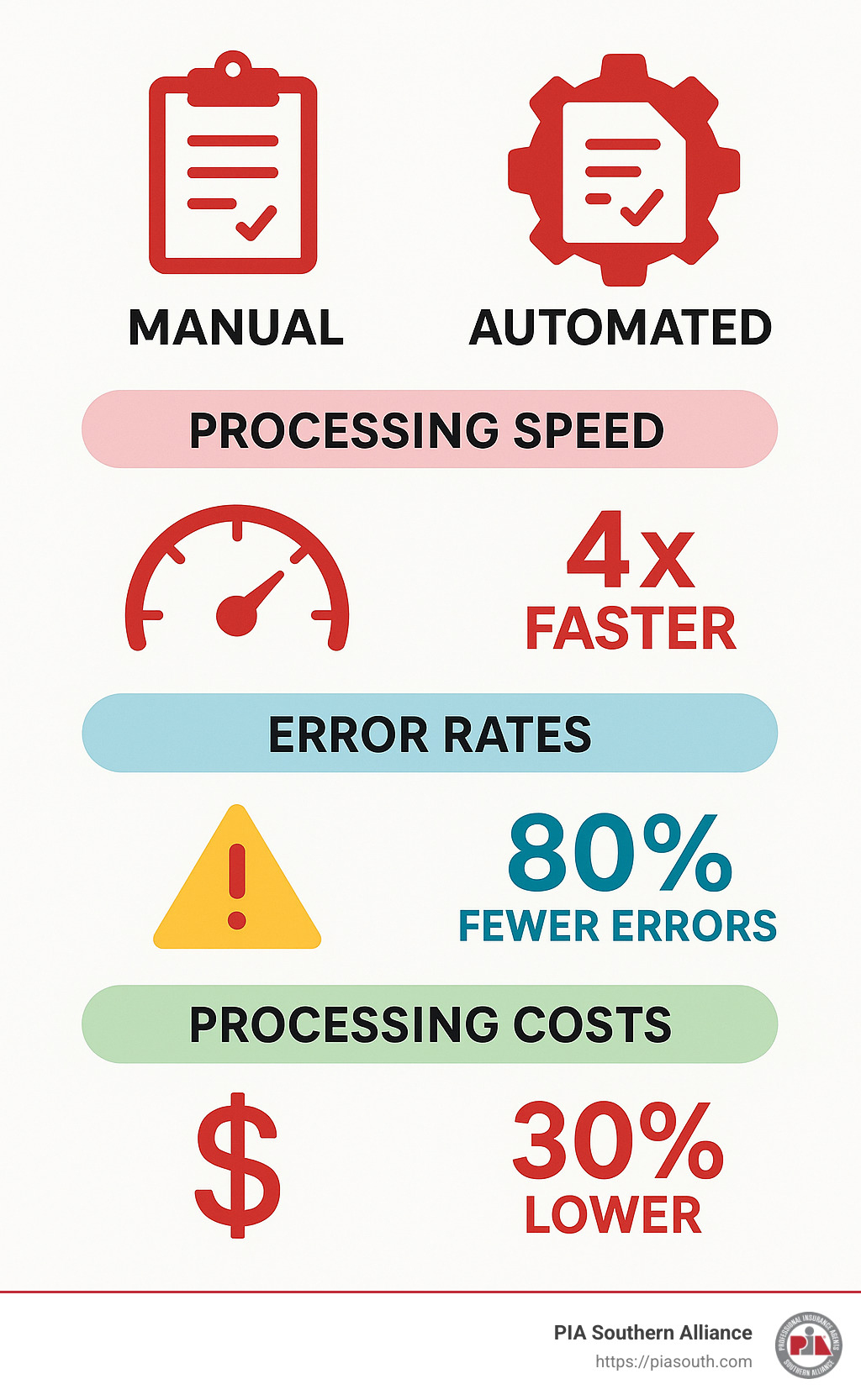
| Digital FNOL intake via mobile apps and portals | 4× faster processing speed |
| AI-powered document extraction and validation | Up to 70% reduction in manual work |
| Automated fraud detection and risk scoring | Cost savings of up to 30% |
| Straight-through processing for simple claims | Significantly higher customer satisfaction |
| Digital payment disbursement | Better scalability during catastrophe events |
The contrast with traditional claims handling couldn’t be more stark. Manual processing typically adds 7-10 days to claim settlement timelines—an eternity for policyholders anxiously waiting for funds after a loss. This delay doesn’t just test your clients’ patience; it threatens their loyalty. According to a revealing 2022 Accenture study, a staggering 74% of dissatisfied insurance customers either jumped ship to another provider (26%) or have one foot out the door (48%), primarily due to frustrations with claims handling.
For independent agencies serving communities across Georgia, Alabama, and Mississippi, delivering swift, accurate claims resolutions isn’t just good service—it’s survival.
Why is this shift happening now? The perfect storm of industry pressures has made automation not just desirable but necessary:
Rising customer expectations have fundamentally changed. Your clients compare their insurance experience not just to other agencies but to every digital service they use, from Amazon to Uber. They expect the same speed and convenience from their insurance provider.
Labor shortages continue to challenge claims departments industry-wide, with experienced adjusters becoming harder to find and retain, especially in our southern states.
Catastrophe surges like hurricane season along the Gulf Coast demand scalable processing capabilities that manual systems simply can’t provide.
Fraud costs exceeding $300 billion annually across the U.S. require sophisticated detection tools that can spot patterns human eyes might miss.
Operational inefficiencies silently erode profitability, with each manual touchpoint adding expense without necessarily adding value.
The PIA Southern Alliance understands these challenges intimately. We’re committed to helping independent agents across our tri-state region implement automated claims solutions that improve efficiency while preserving the personal touch that sets local agencies apart from the insurance giants.
Why Read This Guide?
If you’re an independent insurance agent in Georgia, Alabama, or Mississippi, you’re facing challenges your counterparts in other regions might not fully understand. From the seasonal hurricane threats along the Gulf to the tornado outbreaks that can devastate communities across our states, the property and casualty landscape here has its own rhythm and risks.
This guide speaks directly to your reality. We’ve crafted it with the specific pain points of southern independent agents in mind:
When severe weather systems roll through the region, you’re suddenly drowning in claims paperwork while simultaneously trying to be there for clients who may have just lost everything. The emotional and administrative load can be overwhelming.
Your policyholders are increasingly comparing your claims process not just with other insurance providers but with every digital service they use. When they can order groceries with a tap but need to fill out multiple forms to file a claim, the disconnect is jarring.
Large national carriers are pouring millions into automation technologies, potentially leaving independent agencies at a competitive disadvantage if they don’t adapt.
Maintaining your agency’s profitability while delivering the personalized service that sets you apart requires finding efficiencies without sacrificing the human touch.
During catastrophic events, your agency needs to scale up claims handling capacity immediately—without the luxury of hiring and training additional staff.
Whether you operate a small family agency serving rural communities in Mississippi or manage a growing firm in metropolitan Atlanta, understanding how automated insurance claims processing fits into your operation isn’t just about staying current—it’s about ensuring your agency’s future.
The PIA Southern Alliance is committed to helping you steer this digital change with practical solutions custom to the unique needs of independent agents in our southern states.
What Is Automated Insurance Claims Processing?
Automated insurance claims processing transforms the traditional claims journey into a streamlined digital experience. At its heart, it’s about using smart technology to handle claims from first notice of loss all the way through to payment—with minimal human touch points.
Think of it as your agency’s digital claims assistant, working 24/7 to process information, make decisions, and keep things moving forward. When fully implemented, it enables touchless settlement—where straightforward claims flow automatically from filing to payment without manual intervention.
As one insurance tech innovator beautifully summarized: “Claims automation is really the Holy Grail of insurance. Fundamentally, it works on the three most important metrics that insurance companies care about: retention, expenses, and loss ratio.”
The beauty of automated insurance claims processing is how it handles both structured data (like policy numbers and dates) and unstructured information (like photos of damaged property or handwritten notes). Modern systems can:
- Capture claims through any channel your customers prefer
- Extract key details from documents without manual typing
- Validate coverage and policy details in seconds
- Spot potential fraud using sophisticated AI
- Route complex claims to specialists while auto-approving simple ones
- Keep customers updated automatically
- Process payments electronically
- Generate insights to continuously improve your process
For independent P&C agencies across Georgia, Alabama, and Mississippi, this technology isn’t just nice to have—it’s becoming essential to meeting customer expectations for speed and service.
Automated Insurance Claims Processing vs. Manual Handling
The difference between old-school manual claims handling and modern automated insurance claims processing is like comparing paper maps to GPS navigation. Both can get you there, but one is dramatically faster and more efficient.
| Aspect | Manual Claims Processing | Automated Claims Processing |
|---|---|---|
| Initial Claim Filing | Paper forms, phone calls, emails | Digital FNOL via mobile app, portal, or chatbot |
| Data Entry | “Swivel chair” re-entry of data across systems | Automatic extraction and population across systems |
| Document Management | Physical storage, scanning, manual sorting | Intelligent document processing with automatic classification |
| Validation | Manual cross-checking of policy details | Automated validation against policy database |
| Assessment | Physical inspection, manual estimates | Computer vision analysis of damage photos, automated estimation |
| Decision Making | Human adjuster reviews all claims | Rule-based auto-adjudication for simple claims |
| Payment | Check issuance and mailing | Instant electronic payment options |
| Communication | Periodic phone calls, letters | Real-time digital updates, chatbot assistance |
| Fraud Detection | Manual review based on adjuster experience | AI-powered analytics flagging suspicious patterns |
| Catastrophe Response | Overwhelmed systems, significant delays | Scalable cloud infrastructure, consistent processing |
| Cost Per Claim | Higher operational expenses | 30% lower processing costs on average |
| Processing Time | 7-10 days average | 1-3 days average (simple claims in hours) |
| Error Rate | Higher due to manual entry | Reduced by up to 80% |
For agencies across our tri-state region, this comparison highlights both the opportunity and the challenge. Those who accept automation can deliver faster service at lower costs while freeing up staff to focus on complex claims and building client relationships.
Key Steps in an Automated Claims Process
A well-designed automated insurance claims processing workflow feels seamless to your clients while doing complex work behind the scenes. Here’s what happens at each stage:
The digital intake kicks everything off when your client reports a claim through your agency’s app or portal. The system already knows who they are and pre-fills information from their policy. They simply confirm details, upload photos, and submit—all from their smartphone, often within minutes of the incident.
Behind the scenes, intelligent data extraction goes to work. Advanced OCR technology reads documents while computer vision analyzes damage photos. The system pulls out all the relevant information—dates, locations, policy numbers, damage descriptions—without anyone having to type it in manually.
Automated validation happens next, as the system cross-checks the claim details against the policy. Is coverage in force? Are the claimed items covered? Are there any exclusions that apply? The system answers these questions almost instantly.
Fraud detection runs silently in the background, with AI models analyzing the claim for any suspicious patterns. Claims with unusual characteristics or that match known fraud indicators get flagged for closer review, while straightforward claims move ahead.
The decision engine then determines the next steps. Simple claims might proceed straight to payment, while more complex situations get routed to the right specialist. The system can even set appropriate reserves based on the claim characteristics.
Finally, digital payment and closure wrap things up cleanly. Your client receives payment electronically, signs any releases digitally, and the system handles all the documentation and archiving automatically.

For independent agencies across Georgia, Alabama, and Mississippi, implementing even parts of this automated workflow can dramatically improve both operational efficiency and customer satisfaction. The PIA Southern Alliance provides resources to help agencies of all sizes begin their automation journey, whether you’re taking first steps or looking to improve existing systems.
Core Technologies Powering Claims Automation
The magic behind automated insurance claims processing isn’t just one technology—it’s a powerful combination of innovations working together to transform how claims are handled. For independent agencies across Georgia, Alabama, and Mississippi, understanding these tools is the first step toward smarter implementation.
OCR & Intelligent Document Processing
Remember those stacks of claim forms, police reports, and medical records that used to overwhelm your desk? Intelligent Document Processing (IDP) is changing that reality forever.
Modern IDP goes far beyond old-school OCR (Optical Character Recognition) by adding a layer of artificial intelligence that actually understands what it’s reading. The beauty of today’s systems is their template-free extraction capabilities—they can make sense of virtually any document format without needing pre-defined templates.
These systems also include confidence thresholds that flag when human review might be needed. For example, if the system is 98% certain it correctly read an invoice amount, it proceeds automatically. If it’s only 70% confident about a handwritten note, it routes that element for human verification.
What’s particularly impressive for agencies concerned about compliance is the explainability factor—modern systems can actually show how they interpreted documents, creating an audit trail that regulators appreciate.
One Nordic insurer found that after implementing IDP, 70% of claims documents were correctly processed without human intervention. Imagine what that kind of efficiency could do for your agency during busy seasons!
Robotic Process Automation for Legacy Systems
Many independent agencies across our tri-state region face a common challenge: how do you automate when you’re still running systems from the early 2000s? This is where Robotic Process Automation (RPA) shines.
Think of RPA as your tireless digital assistant that works with your existing systems exactly as a human would. These software “robots” can perform screen-scraping to gather information from one system and input it into another—perfect for agencies juggling multiple carrier portals and agency management systems.
RPA bots excel at handling rule-based tasks without errors, working 24/7 without coffee breaks, and managing exception handling based on criteria you define. For a small agency in rural Alabama or Mississippi, this could mean automating routine claims data entry while your team focuses on the personal touch that keeps clients loyal.
The ROI can be impressive, too. Industry data shows RPA implementations often achieve up to 200% return in just the first year—making it an accessible starting point for automation even with limited technology budgets.
Analytics & Machine Learning for Fraud Detection
With insurance fraud costing more than $300 billion annually in the U.S., the ability to spot suspicious patterns is more valuable than ever. Modern automated insurance claims processing uses advanced analytics and machine learning to identify potential fraud faster and more accurately than human review alone.
These systems continuously analyze historical claims data to identify fraud patterns that might escape notice otherwise. They create predictive models that automatically score incoming claims for fraud risk, and they excel at detecting anomalies that warrant further investigation.
The FBI has recognized these technologies as game-changers in the fight against insurance fraud. For more information on insurance fraud detection, visit the FBI’s Insurance Fraud page. For agencies across Georgia, Alabama, and Mississippi, these tools are particularly valuable during hurricane season or after tornado outbreaks when claim volumes surge and fraudsters try to take advantage of the chaos.
Internet of Things & Telematics
The Internet of Things (IoT) and telematics are revolutionizing how claims begin—and in some cases, preventing them entirely. This technology is particularly exciting for property and auto insurance.
In homes across the Southeast, water sensors can now detect leaks and automatically initiate claims, potentially turning what might have been a major loss into a minor inconvenience. Smart home systems report fires or break-ins in real-time, and connected devices provide valuable data on property conditions before and after losses.
For auto insurance, the change is equally impressive. Telematics devices can now report accidents automatically, vehicle sensors provide objective data about collision severity, and GPS data verifies location and timing of incidents—eliminating disputed facts that often delay claims.
A recent partnership between Motive and Sentry Insurance highlights this trend. Customers using Motive’s Driver Safety Solution can save up to 5% on their Sentry insurance premiums by sharing ELD and dashcam data. As Nick Saeger from Sentry notes: “The data we gather through Motive will help us bolster our safety programs and in-house claims service even further. Telematics data could also serve as the next pricing frontier.”

For independent agents looking to stay at the forefront of these technological advances, the PIA Southern Alliance offers resources to help you steer these changes. Learn more about implementing these technologies in your agency through our Insurance Agency Automation Systems resources.
Implementing an Automated Claims Workflow
Turning your agency’s claims process from manual to automated isn’t an overnight change—it’s a journey that requires thoughtful planning and execution. For independent agencies across Georgia, Alabama, and Mississippi, here’s a practical roadmap to bring automated insurance claims processing into your operation without overwhelming your team or budget.
Phase 1 – Assess & Prioritize Processes
Before investing in new technology, take time to understand where automation will make the biggest impact in your agency.
Start by creating an impact matrix that plots your various claims processes according to volume and complexity. Those high-volume, repetitive tasks—like windshield claims or minor water damage reports—often deliver the quickest return on investment. One Alabama agency found that simple auto claims represented 40% of their volume but consumed 25% of staff time—making them perfect candidates for automation.
Next, evaluate your readiness for each process. How clean is your data? Does your current technology stack support integration? Are there specific regulatory requirements in Georgia, Mississippi, or Alabama that might affect automation?
Remember to bring your team along on this journey. As one Mississippi agency owner put it, “The best automation plan in the world will fail if your staff sees it as a threat rather than a tool.” Involve your claims handlers early—they know the pain points better than anyone and can become your strongest advocates for change.
Phase 2 – Build the Automated Intake Layer
The claim intake process—that crucial first touchpoint with a policyholder in distress—offers a perfect starting point for automation.
Today’s policyholders expect the convenience of reporting claims digitally. Mobile apps that allow customers to photograph damage, upload documents, and provide basic information create a win-win: customers appreciate the convenience while your agency captures structured data from the start.
Consider implementing chatbots that can guide customers through the FNOL process 24/7. These conversational interfaces can collect the same information a human would, but never need sleep or coffee breaks. One Georgia agency found their chatbot handled 35% of initial claims reporting, primarily during off-hours when staff weren’t available.
The key is creating a “zero-touch” upload capability where documents flow directly into your processing system without manual intervention. This eliminates the data entry stage where so many errors traditionally occur.
Phase 3 – Orchestrate Decision Engines
At the heart of automated insurance claims processing lies the intelligence that decides how each claim should be handled.
Start with straightforward business rules—if a claim meets criteria A, B, and C, then process it automatically. For example, a homeowner claim under $5,000 with no structural damage and clear coverage might be approved without human review.
As your comfort with automation grows, consider integrating more sophisticated ML models for tasks like fraud detection or damage assessment. These systems can analyze patterns that humans might miss—like a claimant who’s filed similar claims with different carriers or damage patterns inconsistent with the reported cause.
Always maintain a “human-in-the-loop” approach, especially when serving communities across our tri-state region where personal relationships matter. Set confidence thresholds that determine when a claim requires human judgment, and create clear escalation paths for complex cases.
Document everything. In the insurance world, being able to explain why a decision was made isn’t just good business—it’s often a regulatory requirement. Your automation system should create comprehensive audit trails that satisfy both internal and external compliance needs.
Phase 4 – Integrate Payments & Customer Communication
The final mile of claims processing—payment and communication—significantly impacts customer satisfaction and retention.
Digital payment options like ACH transfers, virtual cards, and mobile wallet deposits can reduce settlement time from days to minutes. After devastating tornado outbreaks in Alabama, agencies using digital payments were able to get emergency funds to policyholders within hours, while those relying on paper checks left customers waiting days for relief.
Pair quick payments with proactive communication. Automated status updates via text or email keep customers informed without requiring staff time. One Mississippi agency implemented automated milestone alerts and saw their post-claim NPS score increase by 18 points in just six months.
Customers want options. Some prefer fully digital experiences, while others—particularly in our more rural communities—may still value phone conversations. Design your system to support omnichannel communication, allowing customers to seamlessly switch between digital and human interaction while maintaining consistent information across all touchpoints.
Phase 5 – Measure & Iterate on KPIs
The implementation of automated insurance claims processing isn’t complete when the system goes live—it’s when you start measuring results and making improvements.
Track meaningful metrics like total cycle time from FNOL to settlement, cost per claim, touchless rate (percentage of claims handled without human intervention), and customer satisfaction scores. Break these down by claim type to identify where your automation is performing well and where it needs refinement.
One Georgia agency finded their automation worked beautifully for auto claims but struggled with commercial property claims. By analyzing the differences, they adjusted their business rules and saw commercial property automation success rates improve by 40% in three months.
The beauty of modern cloud-based systems is their flexibility. As your agency grows and evolves, your automation can evolve with you. Start with the processes that offer quick wins, then expand as you build confidence and expertise.

Benefits of Automated Insurance Claims Processing for P&C Insurers
The shift to automated insurance claims processing delivers game-changing benefits for property and casualty insurers and the independent agencies representing them across Georgia, Alabama, and Mississippi. Let’s explore how these technologies are changing both customer experiences and bottom lines.
Policyholder Experience Change
When we talk with agencies about why they’re considering automation, the improved customer experience almost always tops their list of priorities.
Today’s policyholders expect the same digital convenience from their insurance that they get from online shopping or banking. Automated insurance claims processing delivers exactly that through self-service portals and apps that empower customers to file claims whenever and wherever it’s convenient for them.
Instead of leaving anxious customers wondering about their claim status, automation enables real-time updates through their preferred communication channels. A homeowner in coastal Alabama dealing with storm damage doesn’t have to repeatedly call for updates—they can simply check their app or receive automatic text notifications as their claim progresses.
This transparency builds tremendous trust. When policyholders can see exactly what’s happening with their claim, they feel more confident in both their agency and their carrier. The consistency of automated processing also ensures that every customer receives the same high-quality service, regardless of claim volume or staffing challenges.
The impact on customer loyalty is substantial. According to Accenture’s 2022 study, claims dissatisfaction drives 74% of unhappy insurance customers to either switch providers (26%) or seriously consider it (48%). By delivering faster, more transparent claims experiences, automation directly strengthens client relationships and boosts retention rates for independent agencies across our tri-state region.
Operational & Financial Impact
The business case for automated insurance claims processing becomes even more compelling when you look at the numbers:
Processing costs typically drop by 50–65% through automation, creating substantial operational savings. Claims that once took 7-10 days can now be resolved up to four times faster, delighting customers while reducing administrative overhead.
For independent agencies juggling multiple responsibilities, the reduction in paperwork is particularly valuable. Automation can eliminate up to 70% of manual document handling while reducing processing errors by as much as 80%. This means fewer follow-up calls, fewer corrections, and more time for productive client service.
The improved accuracy and efficiency translate directly to financial benefits. Lower expense ratios come from reduced processing costs, while improved loss ratios result from better fraud detection and more accurate settlements. The combination creates a powerful impact on profitability.
Perhaps most importantly for agencies in hurricane-prone regions of Mississippi and Alabama or tornado-susceptible areas of Georgia, automated systems provide crucial scalability during catastrophe events. When claims surge after a major storm, automated systems continue processing efficiently without the proportional staffing increases that would otherwise be necessary.
The ROI can be remarkable. One Fortune 50 insurer achieved a 300% return on their claims automation investment—proof that these technologies deliver real financial value alongside their operational benefits.
Beyond the direct financial returns, automated insurance claims processing creates a comprehensive audit trail that supports both regulatory compliance and loss analysis. This improved data collection enables more sophisticated reporting and analytics, helping agencies identify trends and make better strategic decisions.
Risk Management & Fraud Mitigation
The third major benefit area is particularly crucial in our current environment where insurance fraud costs exceed $300 billion annually nationwide and affects approximately 10% of all property-casualty claims.
Automated insurance claims processing systems use AI and machine learning to spot suspicious patterns that even experienced human adjusters might miss. These systems analyze hundreds of data points across claims, identifying connections and anomalies that could indicate fraud.
For independent agencies, this technology provides an additional layer of protection without requiring specialized fraud investigation expertise. The systems consistently apply screening protocols even during catastrophe events when human resources are stretched thin—exactly when fraud attempts often increase.
Early warning systems flag potential issues before they become significant problems, enabling proactive intervention. For example, an automated system might identify a pattern of questionable water damage claims in a particular Georgia neighborhood, allowing for closer investigation before multiple payments are made.
The improved data collection and analysis also supports better risk assessment and pricing decisions. When agencies understand loss patterns more clearly, they can work with clients on more effective risk management strategies and advocate more effectively with carriers on rating issues.
All of this happens while maintaining comprehensive audit trails that support both regulatory compliance and any necessary investigations. For agencies navigating the different regulatory requirements across Georgia, Alabama, and Mississippi, this consistency and documentation is particularly valuable.

Overcoming Challenges & Ensuring Compliance
Let’s be honest – implementing automated insurance claims processing isn’t without its problems. For independent agencies across Georgia, Alabama, and Mississippi, the path to automation comes with some real-world challenges that need thoughtful solutions. The good news? With the right approach, these obstacles are entirely manageable.
Data Security & Regulatory Guardrails
When you’re handling sensitive claim information – from medical records after a car accident to financial details after a home burglary – security isn’t optional, it’s essential.
Insurance claims are treasure troves of personal information, making them prime targets for data breaches. Protecting this data requires multiple layers of defense. Encryption should be your first line of protection, securing information whether it’s being transmitted or stored. Your automation system should also include role-based access controls that ensure staff members can only view information relevant to their specific responsibilities.
Don’t forget about creating comprehensive audit logs that track who accessed what information and when. These aren’t just good security practices – they’re often required for compliance with regulations that affect agencies in our tri-state region.
“We implemented our claims automation system with security as the foundation, not an afterthought,” shared one agency owner in Atlanta. “It actually helped us strengthen our overall data protection practices.”
Georgia, Alabama, and Mississippi each have their own specific insurance regulations, including different timeframes for claim acknowledgment and settlement. Your automated system needs to be flexible enough to accommodate these state-specific requirements while maintaining consistent security standards.
Change Management & Talent Upskilling
Technology is only half the automation equation – the human element is equally important.
Many independent agencies have loyal staff who’ve been processing claims the same way for decades. Suddenly introducing automation can feel threatening if not handled with care. The most successful implementations involve staff early in the process, helping them understand how automation will actually make their work more rewarding by eliminating tedious data entry and allowing them to focus on what humans do best – building relationships and solving complex problems.
Staff training should be comprehensive but digestible, focusing on practical applications rather than technical details. As your team adapts to new systems, process redesign often becomes necessary to fully leverage automation capabilities. This is also an opportunity to rethink role evolution – helping your claims staff transition from data processors to customer advocates and complex claim specialists.
One Mississippi agency found success by creating “automation champions” within their team – staff members who acceptd the new technology and helped their colleagues see its benefits. These champions became invaluable resources during the transition period, providing peer-to-peer support that was often more effective than formal training.
Integrating With 18-Year-Old Core Systems
Perhaps the most technical challenge facing agencies is connecting modern automation tools with legacy systems that weren’t designed for today’s digital ecosystem.
The average insurance company relies on core systems that are approximately 18 years old – practically ancient in technology terms. These systems often lack modern integration capabilities, making it difficult to implement new automation tools without significant disruption.
Fortunately, there are several approaches to bridge this gap. API gateways can create modern interfaces for legacy systems, while RPA bridges can automate interactions with systems that lack APIs altogether. Many agencies find success with a phased migration strategy that gradually modernizes their technology stack without disrupting day-to-day operations.
Cloud integration offers another solution, enabling new capabilities while preserving existing investments. This approach allows agencies to implement automation incrementally, starting with the most impactful processes while maintaining connectivity with legacy systems.
A Georgia-based agency recently shared their experience: “We were worried our dated agency management system would prevent us from implementing claims automation, but by using RPA to bridge the gap, we were able to achieve 60% automation without replacing our core system.”
For independent agencies looking to implement automated insurance claims processing while ensuring compliance, the PIA Southern Alliance provides resources and guidance custom to the specific needs of agencies in our region. From compliance checklists to integration strategies, we help agencies steer the challenges of automation while maximizing its benefits.
For more information about supporting your commercial claims processes, visit our Commercial Claims Support resource center.
Future Trends & KPIs to Track
The world of automated insurance claims processing continues to evolve at breathtaking speed. For independent agencies across Georgia, Alabama, and Mississippi, staying ahead of these trends isn’t just about remaining competitive—it’s about changing how you serve your clients and run your business.
Key Performance Indicators for Automated Insurance Claims Processing
When you’re investing in automation, you need clear ways to measure success. Think of these KPIs as your agency’s dashboard—they tell you if you’re heading in the right direction:
Touchless rate shows the percentage of claims that flow through your system without human intervention. This is perhaps the clearest indicator of how well your automation is working. A higher touchless rate means your staff can focus on complex cases that truly need their expertise.
Straight-through processing percentage measures claims that move automatically from first notice of loss all the way to payment. This is the gold standard of claims automation, representing complete end-to-end processing.
The cycle time reduction metric reveals how much faster claims are being settled compared to your pre-automation baseline. For your policyholders, this is often the most noticeable improvement—getting paid in days rather than weeks makes a lasting impression.
Cost per claim helps you understand the financial impact of your automation efforts. As this number drops, your operational efficiency improves, directly affecting your bottom line.
Your fraud detection rate shows how effectively your automated systems are identifying potentially fraudulent claims. With fraud costing the industry billions each year, even small improvements here can have significant financial benefits.
Customer Net Promoter Score (NPS) tells you how likely your clients are to recommend your agency based on their claims experience. In our relationship-driven business, this metric matters tremendously.
Adjuster productivity measures how many claims your staff can handle with automation assistance. As this number rises, you’ll find your team can manage growth without proportional staffing increases.
First contact resolution rate reveals how often claims are resolved during the initial interaction—a key driver of customer satisfaction.
Lastly, claims leakage measures the gap between optimal and actual claim costs, helping you identify opportunities for further improvement.
What Comes Next for Georgia-Alabama-Mississippi Agencies
For independent agencies in our region, several emerging technologies and approaches will shape the future of claims automation:
Generative AI is already changing how we communicate with clients. Soon, these systems will draft personalized claim acknowledgments, status updates, and settlement letters—all with a natural, human touch that maintains your agency’s voice.
Predictive analytics will help you identify which policies are most likely to experience claims, allowing for proactive risk management. Imagine calling a client before storm season to suggest preventive measures based on their specific risk profile.
Parametric insurance products are gaining traction, using automation to deliver instant payouts based on objective triggers like wind speed or rainfall amounts. For agencies in hurricane-prone coastal Alabama and Mississippi, these products could revolutionize catastrophe response.
Drone imagery is becoming standard for property inspection, particularly after widespread disasters. When the next hurricane hits the Gulf Coast, drones will provide detailed damage assessments before physical access is even possible.
Serverless scaling provides cost-effective capacity during claim surges. Instead of maintaining expensive infrastructure year-round, agencies can automatically scale processing capacity during catastrophe events that frequently impact our tri-state region.
Catastrophe response bots will help manage the communication flood during regional disasters. When tornadoes tear through Georgia or hurricanes strike the coast, these systems can handle routine inquiries, freeing your team to address complex cases.
Sustainability metrics are becoming part of claims processes as insurers recognize the opportunity to “build back better” after losses. This approach resonates with increasingly environmentally conscious consumers across our region.
Our states face unique catastrophe risks—from hurricanes along the Gulf Coast to tornadoes in the interior. Automated systems that can scale during these events provide particular value to agencies in Georgia, Alabama, and Mississippi.
The regulatory landscape continues to evolve as well. Each of our three states has different requirements for claim acknowledgment and settlement timeframes. Staying informed about these changing regulations ensures your automated systems remain compliant while delivering the service your clients expect.
The PIA Southern Alliance remains committed to helping independent agencies steer these changes, offering resources and guidance on implementing Insurance Agency Automation Systems that can transform your efficiency while maintaining the personal touch your clients value.
Frequently Asked Questions about Automated Insurance Claims Processing
How does automated insurance claims processing improve fraud detection?
Fraud prevention is one of the most compelling benefits of automated insurance claims processing. The old days of relying solely on experienced adjusters to spot suspicious claims are giving way to much more sophisticated approaches.
Think about how limited human review can be – even the best adjuster can only handle so many claims and might miss subtle patterns. Modern automation tools, on the other hand, can analyze thousands of claims simultaneously, spotting connections that would be impossible for any individual to detect.
What makes these systems so effective is their ability to learn and improve over time. As they process more claims data, they become increasingly skilled at distinguishing between legitimate claims and potential fraud. They’re also completely consistent – every single claim gets the same thorough analysis, eliminating the variability that comes with human review.
For independent agencies across Georgia, Alabama, and Mississippi, this technology is a game-changer, especially during catastrophe events when claim volumes spike dramatically. When a hurricane hits the Gulf Coast or a tornado outbreak affects multiple communities, these systems maintain vigilant fraud screening even as human resources are stretched thin.
Perhaps most importantly, good automation actually reduces false positives. Nobody wants to put loyal customers through unnecessary investigations. Advanced systems are getting better at identifying truly suspicious activity while allowing legitimate claims to proceed smoothly, creating a better experience for honest policyholders.
What challenges arise when integrating automation with legacy systems?
Let’s be honest – the insurance industry isn’t exactly known for cutting-edge technology. Many agencies and carriers across our tri-state region are working with systems that were implemented when flip phones were still cutting-edge technology!
The average insurance company core system is about 18 years old. That creates some real headaches when trying to implement automated insurance claims processing. These legacy systems often store data in formats that are difficult to access programmatically, lack modern APIs for integration, and weren’t designed with automation in mind.
There’s also the very real concern about system performance. Poorly designed integrations can slow down already-taxed legacy systems, creating frustration for both staff and customers. And of course, any time you’re connecting systems, security becomes a major consideration – the last thing any agency wants is to create new vulnerabilities while trying to improve efficiency.
Fortunately, there are practical solutions to these challenges. Many agencies have found success with robotic process automation (RPA) tools that can interact with legacy systems through their existing interfaces – essentially mimicking the actions a human would take. API gateways can provide modern connection points for older systems, and middleware solutions designed specifically for insurance integrations can bridge the gap between old and new.
The key is taking a phased approach. Trying to automate everything at once is a recipe for disaster. Smart agencies start with one high-value process, prove the concept, and then gradually expand their automation footprint.
Which KPIs best measure success after implementing automation?
When implementing automated insurance claims processing, tracking the right metrics is essential to understand if you’re actually getting the benefits you expected. But with so many possible measurements, which ones really matter?
Cycle time is perhaps the most important metric for both your agency and your customers. How long does it take from first notice of loss to settlement? Reducing this timeframe directly impacts customer satisfaction and your operational efficiency. For independent agencies in Georgia, Alabama, and Mississippi, faster cycle times are especially critical during catastrophe events when policyholders are particularly anxious for resolution.
Touch rate is another vital metric – what percentage of claims still require human intervention? A lower touch rate generally indicates more effective automation, though some complex claims will always need human expertise. The goal isn’t necessarily zero touches, but rather ensuring your staff is focused on claims that truly benefit from their judgment.
Of course, financial metrics matter too. Cost per claim helps you understand if automation is delivering the operational savings it promised. Are you processing more claims with the same staff? Are you reducing expenses associated with manual processing?
Don’t forget the policyholder perspective. Customer satisfaction scores or Net Promoter Score (NPS) measurements provide crucial feedback on whether automation is enhancing or potentially harming the customer experience. The best automation improves both efficiency and satisfaction simultaneously.
For a comprehensive view, consider tracking adjuster productivity as well. Are your claims professionals handling more claims or more complex claims than before? Are they spending less time on data entry and more time on meaningful customer interactions?
The most successful agencies use a balanced approach to measurement, looking at operational, financial, and customer experience metrics together to get a complete picture of their automation success.
Conclusion
The landscape of insurance claims is changing before our eyes. Automated insurance claims processing isn’t just a fancy tech trend—it’s becoming the backbone of successful independent agencies across Georgia, Alabama, and Mississippi. For agencies looking to thrive in today’s competitive market, embracing these technologies isn’t optional anymore.
Think about what automation brings to your agency’s table: claims that once took weeks now resolve in days or even hours. Your staff spends less time on paperwork and more time building relationships with clients. When catastrophe strikes—whether it’s hurricane season along the Gulf Coast or tornado outbreaks across our tri-state region—your agency can scale to meet demand without drowning in paperwork.
The journey toward automation doesn’t happen overnight, but it follows a clear path. Start by examining your current processes to identify where automation will make the biggest impact. Build a digital front door for claims with user-friendly apps and portals. Implement smart decision engines that know when to process claims automatically and when to involve your experienced team. Connect everything with seamless payment and communication systems. And always measure your results, learning and improving with each claim.
What makes independent agencies special isn’t going away—it’s being improved. The personal touch and local knowledge you provide become even more valuable when freed from administrative burdens. Automated insurance claims processing doesn’t replace the human element; it amplifies it by removing the tedious tasks that drain your team’s energy and creativity.
The PIA Southern Alliance stands ready to support your agency through this change. We’ve developed resources specifically for independent agencies in our region, recognizing the unique challenges and opportunities you face. From education to advocacy, we’re committed to helping you steer this changing landscape successfully.
By combining cutting-edge automation with your agency’s personal service, you create something truly powerful—an insurance experience that builds lasting loyalty and drives sustainable growth. Your clients get faster service and more transparent communication. Your team focuses on complex claims and meaningful customer interactions. And your business becomes more resilient, efficient, and profitable.
The future of claims processing is undoubtedly automated, but the heart of insurance remains human connection. With the right approach to automated insurance claims processing, your independent agency won’t just survive in this new environment—you’ll thrive, delivering exceptional service while maintaining the personal relationships that set you apart.
For more information about implementing automated claims solutions in your agency, explore our resources on Insurance Agency Automation Systems or Commercial Claims Support.