
Finding affordable E&O insurance isn’t about chasing the lowest possible price. It’s about finding the sweet spot—that perfect balance between rock-solid protection and a premium that doesn’t cramp your agency's style. Think of it as securing high-value coverage that acts as a financial fortress for your business, not just another bill to pay. This guide will show you how to find that balance.
What Affordable E&O Insurance Really Means for Your Agency
For any independent agency in Georgia, Alabama, or Mississippi, Errors and Omissions (E&O) insurance is more than a line item on an expense report. It's a core investment in your agency's future. It's the partner you have in your corner that safeguards everything you've built.
True affordability isn't found by grabbing the cheapest quote you can find. That's a fast track to dangerous coverage gaps that can leave you exposed when you need protection the most. Instead, an affordable E&O policy delivers robust coverage that’s built for your specific operations, all without choking your ability to invest in growth. It’s that ideal point where your premium reflects your actual risk, and your policy is strong enough to handle a worst-case scenario. This ensures a single client complaint or an alleged mistake doesn't bring your entire business down.
Moving Beyond Price Tag to Value
To get there, you have to shift your thinking. Stop asking, "What's the cheapest E&O policy I can get?" Instead, ask, "What's the most cost-effective way to protect my agency?" The answer lies in understanding the moving parts that determine your premiums and taking control of them.
An affordable policy is one you can comfortably keep in force, year after year, ensuring there are no gaps. Letting your coverage lapse to save a little cash today could expose your agency to devastating, uncovered claims from your past work.
This guide is designed to give you a playbook of real, actionable strategies to lock in that value. We'll walk through how to make your agency a more attractive risk to underwriters, which directly translates to lower costs. We'll hit on a few key areas:
- Risk Management: Putting clear, documented procedures in place to minimize the chance of errors.
- Operational Excellence: Building a culture of diligence, double-checking, and continuous learning.
- Strategic Partnerships: Using the power of organizations like PIA Southern Alliance to unlock better rates and terms.
Ultimately, getting affordable E&O insurance is about smart, proactive risk management, not last-minute, reactive cost-cutting. By the time you're done here, you'll have a clear roadmap to protect your agency the right way—effectively and sustainably.
Understanding the Factors That Drive Your E&O Premiums
Getting a handle on affordable E&O insurance starts with seeing your agency through the eyes of an underwriter. Think of them as a home inspector for your business. They aren't just giving it a quick once-over; they're in the crawlspace checking the foundation and in the attic looking at the wiring, all to figure out the odds of a future problem.
Every single detail, from the types of policies you write to the exact procedures your team follows, gets woven into your agency's unique risk profile. Once you have a firm grasp of these factors, you can start making smart adjustments that not only strengthen your agency but also make it a much more attractive risk to insurers.
It's all about finding the right balance between protection and affordability to build a stable future for your agency.
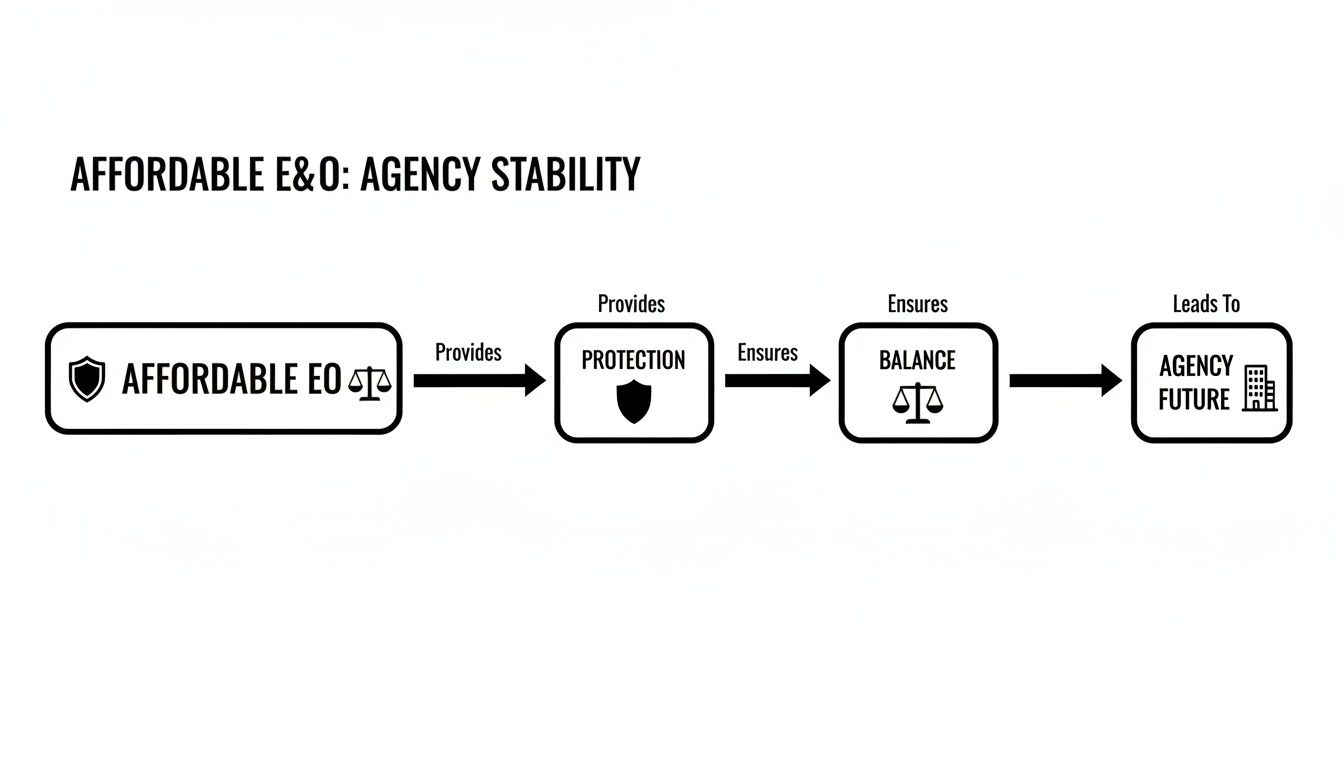
This isn’t just about slashing costs. True affordability comes from strategically balancing comprehensive protection with smart risk management, ensuring your agency can stand strong for the long haul.
Your Agency Operations and Specializations
The first place an underwriter looks is at the very core of your business. An agency that mainly handles standard personal auto and home policies is a completely different animal than one writing complex liability coverage for high-risk industries. It’s just common sense.
The more complex the products you sell, the greater the chance for a costly mistake. Underwriters will zoom in on a few key areas:
- Lines of Business: Are you heavily involved in high-stakes fields like construction, healthcare liability, or professional services? These niches require deep expertise and naturally carry a higher potential for massive claims.
- Agency Revenue and Size: It’s a simple numbers game. Bigger agencies with higher revenues have more exposure. More clients, more policies, and more transactions just create more opportunities for something to slip through the cracks.
- Staff Experience: A team of seasoned pros with decades in the trenches and a wall full of designations is always viewed more favorably than a crew of brand-new, unlicensed trainees. Experience signals a much lower likelihood of simple, preventable mistakes.
Internal Controls and Risk Management
What you sell is only half the story; how you sell it is just as important. Your best defense against a claim—and your most powerful tool for negotiating lower premiums—is having documented, consistent internal processes. Insurers want to see that you’ve built a system to catch errors before they ever happen.
Your rates can swing dramatically based on the strength of your internal risk management. They’ll be looking for things like:
- Documented Workflows: Do you have standard checklists that everyone follows for quoting, binding, and servicing policies?
- Client Communication Protocols: How do you document phone calls, confirm coverage changes in writing, and manage client expectations to avoid misunderstandings?
- Continuing Education: A commitment to ongoing training shows that your team is staying on top of industry changes and learning from others’ mistakes.
To an underwriter, a well-documented procedure isn't just red tape—it's a guardrail. It proves your agency operates with a repeatable, professional process designed to protect both the client and your business.
Taking a proactive approach here is critical. The demand for E&O is only growing. The global market was valued at USD 8.89 billion and is expected to climb to USD 15.0 billion by 2035. As litigation risks rise, this coverage becomes more essential, and tightening your internal controls is one of the most direct ways to manage your costs in this expanding market.
To give you a clearer picture, here’s a breakdown of how underwriters might view different agency profiles.
E&O Premium Influencers High-Risk vs Low-Risk Agency Profile
This table shows how different factors can push your agency into a higher or lower premium bracket.
| Factor | Higher-Risk Profile (Higher Premiums) | Lower-Risk Profile (Lower Premiums) |
|---|---|---|
| Lines of Business | Specializes in high-limit commercial, construction, or professional liability. | Focuses on standard personal lines (auto, home) and small commercial. |
| Documentation | Inconsistent or non-existent written procedures. Verbal confirmations only. | Standardized checklists and documented workflows for all key processes. |
| Staff Experience | High turnover, many new or unlicensed staff members, little formal training. | Seasoned team with professional designations (CIC, CPCU) and ongoing CE. |
| Claims History | Multiple claims in recent years, especially if related to similar errors. | Clean claims history or a single, minor claim with corrective action taken. |
| Client Base | Concentrated in litigious or volatile industries (e.g., trucking, healthcare). | Diverse client base across stable, low-risk industries. |
| Auditing | No internal file auditing or peer review process. | Regular internal audits to ensure compliance and quality control. |
As you can see, the agencies that actively manage their operations, document everything, and invest in their people are the ones who earn the best rates.
Your Claims History
It should come as no surprise that your past is a pretty strong predictor of your future risk. An agency with a history of frequent or severe claims is going to face higher premiums, period. Each claim, no matter the outcome, acts as a red flag, signaling a potential crack in your processes.
But a single claim doesn't automatically mean you're uninsurable or stuck with sky-high rates forever. An underwriter will dig a bit deeper and also consider:
- The nature of the claim: Was it a simple clerical error that was quickly fixed, or a major breach of your professional duty?
- Your response: How did you handle it? Most importantly, did you implement new procedures to make sure it never happens again?
A clean claims history is your single most valuable asset when you're shopping for affordable E&O insurance. It's concrete proof that your risk management strategies are actually working. For a deeper look into the carriers that value these practices, check out our guide on top-tier E&O insurance companies.
Actionable Strategies to Lower Your E&O Insurance Costs
Knowing what drives your premium is one thing, but taking control is where the real power lies. Moving from theory to practice is how you’ll lock in affordable E&O insurance without cutting corners on coverage. This isn’t about finding loopholes; it’s about building a stronger, more resilient agency that insurers see as a top-tier, low-risk partner.
Think of your agency like a well-oiled machine. Every standardized process and training session is like preventative maintenance, drastically reducing the chances of a costly breakdown—or in this case, a claim. By shifting to a proactive mindset, you can directly influence your premiums and turn risk management from a necessary expense into a real competitive advantage.

Standardize Your Workflows with Checklists
One of the simplest yet most effective moves you can make is to roll out standardized checklists for every key client interaction. Inconsistent processes are a breeding ground for mistakes. A checklist ensures every single team member follows the exact same steps, every single time, creating a uniform standard of care that’s easy to prove.
For instance, a new business checklist could include mandatory steps like:
- Documenting the client’s stated coverage needs in their own words.
- Confirming in writing any coverages the client declines.
- Verifying all names and addresses against a second source.
- Sending a formal binder with clear effective dates and policy numbers.
These simple, repeatable actions build a bulletproof paper trail. If a claim ever pops up, you have clear, consistent documentation showing you followed a professional and thorough process. That’s worth its weight in gold during a defense.
Develop a Robust Employee Training Program
Your team is your greatest asset, but they can also be your biggest liability. A formal, ongoing training program is absolutely essential for keeping that risk in check. This has to go way beyond basic product knowledge; it should be a deep dive into your agency’s specific procedures and ethical standards.
A solid training program should cover:
- E&O Hotspots: Hold regular sessions on common claim scenarios. Think failing to procure coverage, misrepresenting policy terms, or making certificate of insurance (COI) errors.
- Documentation Standards: Train every employee on what to document, where to save it in your agency management system, and why it's so critical for E&O defense.
- Client Communication Protocols: Role-play tough conversations, like explaining coverage gaps or handling client complaints, to ensure everyone responds professionally and consistently.
A well-trained team doesn't just cut down on errors; it builds a culture of accountability. When every employee understands their role in protecting the agency, your collective risk profile improves dramatically.
Steps like these are exactly what underwriters love to see. A serious focus on risk mitigation is a huge driver in making E&O insurance more affordable. In fact, agencies with fewer claims often see their rates drop over time, with discounts of 10-20% being pretty common after just a few claim-free years.
Implement Regular Internal Audits
You can't fix what you don't know is broken. Think of regular internal file audits as your agency's early-warning system. They help you catch procedural drift, documentation gaps, and potential E&O landmines before they can blow up into a full-blown claim.
Set up a peer-review system where agents audit a small, random sample of each other's files every quarter. Use a simple scoring sheet based on your standardized checklists. This isn't about pointing fingers; it's about collaborative improvement and spotting areas where a little extra training might be needed. Being proactive, like implementing security-first compliance best practices for data protection, also makes a big dent in your agency's risk profile.
Master Your Client Communication
So many E&O claims start from simple misunderstandings. Vague chats, unconfirmed changes, and mismatched expectations can quickly spiral into accusations of negligence. The best way to fight this is with ironclad communication protocols.
- Confirm Everything in Writing: After any important conversation about coverage, send a follow-up email that summarizes the discussion and any decisions made. This creates a time-stamped record.
- Use Coverage Rejection Forms: When a client turns down a recommended coverage (like flood, cyber, or EPLI), have them sign a form. It shows they understood the risk they were taking on.
- Avoid Ambiguous Language: Never, ever say a client is "fully covered." Instead, talk about specific policy forms and limits. Be precise and clear in everything you say and write.
By putting these concrete, actionable strategies into place, you take direct control over your agency's risk profile. Each step not only makes your operation more efficient and professional but also sends a clear signal to insurers: you are a well-managed, low-risk business that deserves the best rates. And for agencies looking to manage cash flow while making these improvements, it’s worth understanding how insurance premium financing works as another strategic tool in your kit.
Navigating Your Policy to Find the Right Coverage
Choosing the right Errors and Omissions policy can feel like you’re trying to read a legal document in a foreign language. It's packed with complex terms and clauses that all sound important, but how do you know which ones actually matter for your agency? Getting affordable E&O insurance isn't just about finding the lowest premium; it’s about knowing exactly what you're buying.
Think of your E&O policy as the blueprint for a house. You wouldn't sign off on it without knowing the difference between a load-bearing wall and a decorative one. This section will break down the key components of an E&O policy, giving you the clarity to pick the right coverage without paying for features you don't need.
Claims-Made vs. Occurrence Policies
Right out of the gate, one of the most critical distinctions you’ll run into is between "claims-made" and "occurrence" policies. It's a fundamental concept, and you need to get this one right because the vast majority of E&O policies are claims-made.
A claims-made policy covers claims that are made and reported while the policy is active, no matter when the actual mistake happened. This means if a client files a claim against you today for work you did two years ago, your current policy has to be in force for you to be covered. Cancel that policy, and you're exposed.
An occurrence policy, which is way more common in general liability, covers incidents that occur during the policy period, regardless of when the claim is eventually filed. Because a professional error can lie dormant for years before it surfaces, the claims-made structure helps insurers manage their long-term risk, which in turn helps keep our E&O premiums from going through the roof.
Understanding Your Policy Limits and Deductible
These are the nuts and bolts of your coverage. Your policy limit is the max amount your insurer will pay on a covered claim, while your deductible (sometimes called retention) is what you pay out-of-pocket before your coverage kicks in. They work like a seesaw—a higher deductible usually means a lower premium, but it also shifts more financial risk onto your agency’s shoulders.
When you're settling on your limits, think about:
- Your Agency's Revenue: More revenue generally equals more exposure.
- Your Client Profile: Are you working with large commercial clients where one slip-up could trigger a massive loss?
- Contractual Requirements: Some of your carriers or larger clients might demand you carry specific minimum limits just to do business with them.
Don't make the classic mistake of picking a sky-high deductible just to save a few bucks on the premium. If you can't realistically write a check for that amount tomorrow, it's not the right deductible. It's all about finding that sweet spot between cost and your real-world ability to handle a loss.
The Importance of Prior Acts Coverage
Since E&O is claims-made, what about all the work you did before your current policy started? That's where prior acts coverage comes in. It's often called a retroactive date, and it’s arguably one of the most important dates on your policy. This date is usually set to the day you first bought continuous E&O coverage and gets carried forward every time you renew.
This little date is a big deal. It ensures your new policy will respond to claims that come from work you did all the way back to that original date. Let your coverage lapse, even for a day, and you risk resetting that date to the present. Suddenly, all your past work is dangerously exposed. This is exactly why maintaining continuous coverage is non-negotiable.
Key Exclusions and Endorsements to Watch For
No policy covers everything. It’s just as important to know what your policy doesn’t cover as what it does. Common E&O exclusions include things like fraud, criminal acts, bodily injury, and property damage (that’s what your GL policy is for).
But you have to dig deeper for the gaps that could really bite you. For example, many standard E&O policies provide very little, if any, real coverage for cyber liability. For agencies in our line of work, especially MSPs and telecom providers, knowing how your policy handles liability from implementing email security best practices for MSPs is critical.
More often than not, a separate, dedicated cyber liability policy is the only way to properly cover risks like data breaches and ransomware attacks. Sometimes, you can use an endorsement to add specific coverage back into a policy for an extra premium, helping you tailor it more closely to what your agency actually does.
How PIA Southern Alliance Unlocks Affordable E&O Coverage
Trying to find affordable E&O insurance as an independent agency can feel like being a small boat in a very big ocean. It often seems like the best rates and the broadest coverage terms are saved for the massive, national brokerage houses.
But what if you could get the advantages of a large corporation while staying completely independent? That’s exactly the power you tap into when you join an association like PIA Southern Alliance. It's the strategic move that levels the playing field, giving your agency in Georgia, Alabama, or Mississippi a direct line to more accessible and cost-effective E&O coverage.
Leveraging Collective Buying Power
The most immediate benefit is simple: strength in numbers. A single agency has to negotiate on its own, but PIASA negotiates on behalf of hundreds of agencies at once. This collective buying power allows the association to work with endorsed E&O partners to secure advantages that are just out of reach for a solo agency.
This translates into real, tangible benefits designed for agents right here in our region:
- Pre-Negotiated Rates: Carriers are willing to offer much more favorable pricing because they're gaining access to a large, pre-vetted group of professional agencies.
- Broader Coverage Terms: PIASA works with its partners to build programs with enhancements and endorsements specifically tailored to the risks independent agents face every day.
- Simplified Applications: Our endorsed partners often have a streamlined application process because they already know the quality and professionalism of PIASA members.
An Ecosystem That Lowers Your Risk Profile
Beyond just getting you access to insurance products, PIA Southern Alliance provides an entire ecosystem of resources that makes your agency a fundamentally better risk in the eyes of any underwriter. When an insurer sees your PIASA membership, they see a commitment to professional excellence. That lowers your perceived risk, which can lead directly to better rates.
Membership isn't just a certificate on the wall; it's a signal to the insurance market that your agency is dedicated to best practices, continuous improvement, and robust risk management. It shows you're invested in doing business the right way.
This support system actively helps you put the kind of risk-management strategies in place that lower premiums. You get access to continuing education, compliance resources, and peer networking that keeps you ahead of industry trends and potential pitfalls—which is critical in a market with growing exposures.
The North American liability market is projected to swell from USD 299.43 billion to USD 460.86 billion by 2034, with professional liability growing fastest at 8.9% annually. For PIA Southern Alliance members, accessing competitively priced, locally endorsed E&O programs is a powerful shield against these rising risks. You can learn more about the expanding liability insurance market and its trends.
A Partner in Your Long-Term Stability
Ultimately, PIASA isn’t just a vendor; it's a strategic partner in your agency's long-term health. By providing access to premier E&O markets and the tools to become a best-in-class agency, the alliance helps ensure your stability and profitability. You’re not just buying a policy—you're joining a community that actively wants you to succeed.
This blend of group buying power and a deep commitment to professional development creates a powerful formula. It unlocks opportunities for affordable E&O insurance that a single agency could never achieve on its own, ensuring you can protect your business without breaking the bank. Explore our professional agents E&O programs to see how membership can directly benefit your agency.
Frequently Asked Questions About E&O Insurance
When you're running an independent agency, the practical, day-to-day questions about Errors and Omissions insurance are often what keep you up at night. Let's cut through the noise and get straight to the answers agency owners need when looking for affordable E&O insurance that actually protects their business.
How Much E&O Coverage Does My Small Agency Need?
Figuring out the right policy limit isn't a guessing game. Picking a number out of thin air is one of the riskiest things you can do, and a one-size-fits-all approach can leave you dangerously exposed. Your decision has to be a calculated one, based on your agency’s specific risk profile.
Several key factors should guide your choice:
- Your Agency’s Revenue: Higher revenue usually means greater exposure and, therefore, a need for higher limits. A common rule of thumb is to carry a limit that's at least twice your annual revenue, but think of that as a starting point, not the finish line.
- Your Client Types: Are you mostly writing small personal lines policies, or are you handling large, complex commercial accounts? A single mistake on a multi-million dollar commercial policy could spark a catastrophic claim, demanding a much higher limit.
- State and Carrier Requirements: Some states have minimum E&O requirements just to keep your license. On top of that, many of your carrier partners will contractually require you to maintain specific minimum limits to hold onto your appointment.
The goal is to land on a limit that can comfortably cover a worst-case scenario claim—including defense costs—without being excessive. Remember, attorney fees alone can easily climb into the tens of thousands, so your limit needs to be substantial enough to handle a long legal fight.
Can I Get E&O Insurance As A Brand-New Agency?
Yes, absolutely. While getting affordable E&O insurance as a new venture can feel like an uphill battle, it's entirely possible. Since underwriters don't have a claims history to look back on, they're going to focus heavily on your professional background and how you've structured your business.
Insurers will want to see:
- Your Personal Experience: How many years have you been a licensed agent? Do you hold professional designations like CIC or CPCU? A strong track record inspires confidence.
- Your Business Plan: A well-documented plan that lays out your target markets, sales processes, and internal controls shows that you’re starting off with a professional, risk-aware mindset.
This is one area where being part of an association like PIA Southern Alliance really pays off. The carrier partners endorsed by PIASA are used to working with new agencies. They get the unique challenges you face and often have programs designed specifically to support startups, which makes the whole underwriting process go a lot smoother.
For a new agency, underwriters aren't just insuring your business; they are insuring you. Your professionalism, experience, and documented commitment to best practices are your most valuable assets when seeking your first E&O policy.
What Is The Biggest Mistake Agencies Make With Their E&O Policy?
The single biggest—and most expensive—mistake an agency can make is letting their coverage lapse. Because nearly all E&O policies are written on a "claims-made" basis, you must have an active policy in force when a claim is reported for coverage to kick in.
If your policy expires, even for a single day, you create a massive gap. This can reset your "prior acts date," which basically wipes out coverage for all the work you did in previous years. A client could file a claim tomorrow for a policy you wrote three years ago, and if you have a coverage gap, you would be completely on your own to pay for your defense and any potential settlement.
Other common but dangerous pitfalls include:
- Failing to Report a Potential Claim: Many policies require you to report any incident that could reasonably be expected to lead to a claim. If you wait until you're officially sued, you could jeopardize your coverage.
- Not Understanding Key Exclusions: Assuming your policy covers things like cyber-attacks or fraudulent acts can be a rude awakening. It's vital to know what is—and isn't—covered before you need to find out the hard way.
Maintaining continuous, uninterrupted coverage is the foundation of any solid risk management plan. It’s the only way to ensure the shield you’ve paid for is actually there when you need it most.
At PIA Southern Alliance, we are committed to helping independent agencies in Georgia, Alabama, and Mississippi protect their hard-earned success. Through our endorsed E&O partners and extensive risk management resources, we provide the tools you need to secure affordable, high-quality coverage. Discover how membership can strengthen your agency by visiting us at https://piasouth.com.